


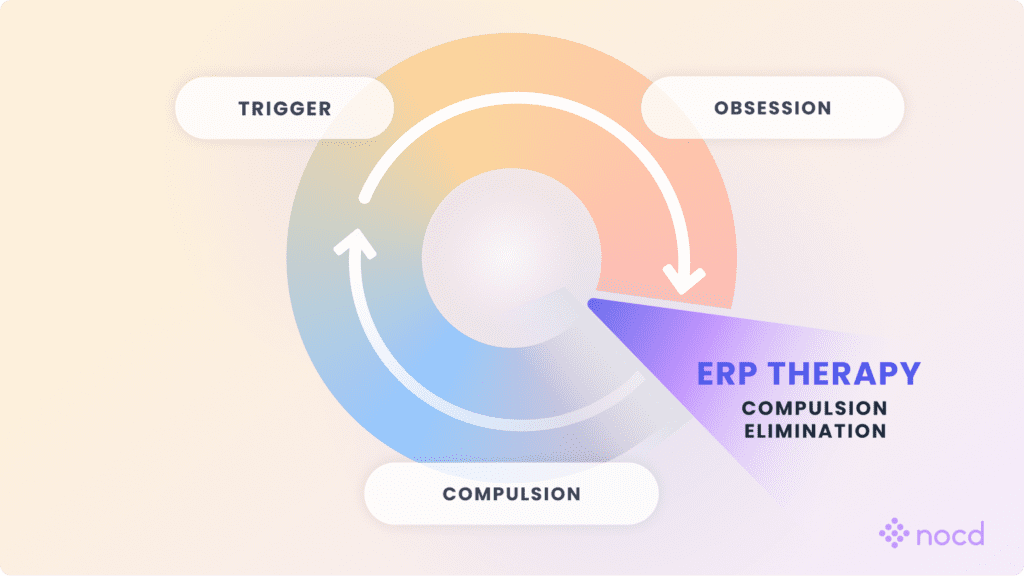
Do you avoid certain places, people, or situations because they trigger overwhelming anxiety? Do you replay conversations for hours trying to make sure you didn’t say or do the wrong thing? Do you constantly seek reassurance, check your feelings, or get stuck in exhausting “what if?” spirals that never fully go away?
ERP might be the answer you’re looking for.
What is ERP?
Exposure and response prevention (ERP) is a specialized form of cognitive behavioral therapy (CBT) that helps people handle fear, anxiety, and uncertainty without resorting to behaviors and coping tactics that compound stress, interfere with daily life, or put the burden on other people.
These behaviors can take many forms. Some people avoid situations that trigger anxiety. Others constantly seek reassurance, replay conversations, check their feelings, research worst-case scenarios, or get stuck in exhausting “what if?” spirals. While these responses may bring short-term relief, they often make fear feel more powerful over time.
The approach is endorsed by the American Psychiatric Association (APA), the National Institute for Health and Care Excellence (NICE), and the World Health Organization (WHO).
How effective is ERP for OCD?
ERP is the gold standard treatment for OCD.
Research consistently shows:
- Around 80% of people with OCD experience significant improvement after ERP.
- The benefits of ERP are often long-lasting, especially when people continue applying the skills they learned in treatment.
- Relapse rates are lower in ERP compared to talk therapy or medication alone.
ERP is effective for all OCD subtypes, no matter how taboo, overwhelming, or difficult the symptoms may feel. Research also supports the use of ERP for children, teens, and adults. Treatment is always adapted to each person’s symptoms and needs.
Real-world outcomes support ERP’s effectiveness. NOCD data shows that members in its teletherapy program experience an average 43% reduction in OCD severity after just 12 weeks of ERP treatment.
Is ERP only used for OCD?
ERP is used to treat OCD and many other anxiety-related conditions rooted in fear, avoidance, and uncertainty. Other examples include:
- Panic disorder
- Social anxiety disorder
- Generalized anxiety disorder (GAD)
- Specific phobias
- Health anxiety
Most anxiety-related disorders are treated with ERP, like panic disorder, social anxiety disorder, generalized anxiety disorder, or phobia.
Tracie Ibrahim, LMFT, CST, Chief Compliance Officer at NOCD
ERP can help people gradually face situations, memories, sensations, or thoughts they’ve been avoiding for years. A specialized form of ERP called prolonged exposure therapy is commonly used to treat post-traumatic stress disorder (PTSD).
How does ERP work?
ERP works by helping people gradually face the thoughts, situations, or triggers they’ve been avoiding—without falling back on the behaviors they normally use to feel safer or more certain.
ERP has two core elements:
- Exposure: Gradually facing thoughts, images, feelings, urges, sensations, or situations that trigger obsessions.
- Response prevention: Resisting the compulsive behaviors that usually follow.
Over time, ERP helps people build confidence in their ability to handle fear, uncertainty, and discomfort without letting anxiety dictate their choices.
In ERP sessions, people typically work through steps like:
- Assessment and education: Understanding symptoms, fears, triggers, and avoidance patterns.
- Exposure hierarchy: Creating a personalized list of ERP exercises that starts with more manageable situations before gradually building toward more difficult ones.
- Gradual exposures: Practicing exposure exercises from the hierarchy while resisting urges to avoid, seek reassurance, check, or perform rituals.
- Homework and real-life practice: Applying ERP skills outside of sessions in everyday situations.
A typical course lasts 12-20 sessions, but treatment length varies depending on symptom severity and progress.
What are some examples of ERP?
Here are some examples of what ERP exercises can look like for different OCD fears and symptoms:
| Obsession | Compulsion | Response Prevention Technique |
| “What if I stab my partner with a kitchen knife?” | Avoiding sharp objects | Practicing safe, therapist-guided exposure with sharp objects |
| “If someone who is sick touches me, I’ll get deathly ill.“ | Excessive handwashing and/or sanitizing | Deliberately touching “contaminated” surfaces without immediately washing hands or sanitizing |
| “If the books on my shelf aren’t perfectly lined up, something bad will happen.” | Repeatedly rearranging or aligning items until they feel “just right” | Purposely leaving books slightly askew or out of order without fixing them |
| “What if my partner isn’t ‘the one?’” | Seeking constant reassurance from your partner or others | Working with your partner to agree to no longer answer questions that have been asked and answered |
| “What if I offend God by thinking about something sinful?” | Excessive prayer and/or confession | Allowing intrusive thoughts, images, or urges to exist without trying to neutralize them |

Find the right OCD therapist for you
All our therapists are licensed and trained in exposure and response prevention therapy (ERP), the gold standard treatment for OCD.
Is ERP used with medication or other therapies?
ERP can be used on its own or alongside other OCD treatments, depending on each person’s symptoms and needs.
- Medication: Selective serotonin reuptake inhibitors (SSRIs) can reduce OCD symptoms and are commonly used alongside ERP.
- Talk therapy: General talk therapy is usually less effective for OCD and can actively make symptoms worse if not specifically tailored to address obsessions and compulsions
- Other therapies: Acceptance and commitment therapy (ACT) and mindfulness approaches can complement ERP, but don’t have the same level of evidence.
Bottom line
Fear, avoidance, reassurance-seeking, and intrusive thoughts can slowly take over daily life—but it doesn’t have to be that way. ERP gives people a structured, evidence-based way to stop organizing their lives around anxiety. With the right support, meaningful recovery is possible.
If you’re interested in starting ERP, look for providers who specialize in the approach, whether in person or online. The IOCDF provider directory and the 100+ therapists in the NOCD therapy directory are good places to begin.